
AI Agents or Automated Workflows? Choosing the Right Approach
Some tasks follow a clear sequence. Others require interpreting unexpected inputs or deciding what to do next. Choosing between a workflow, an agent or a combination starts with those requirements—not with a preference for autonomy. This guide compares the approaches through control, variability, evaluation and operating cost.
By EpicflarePublished Updated 7 min read
Automated workflow
The workflow design defines the sequence.
- Step 1
- Step 2
- Step 3
- Output
Same path on every run; model responses within a step can still vary.
AI agent
The model chooses the next step.
Repeats until done
- Plan the next action
- Use a tool
- Observe the result
The path can differ from one run to the next.
The choice between an automated workflow and an AI agent shapes a system's behavior, scalability, cost and predictability. Understanding the logic of each helps move from a prototype to a solution that can be relied on in production.
It is a choice between orchestration and autonomy. A workflow controls the path the system takes; an agent can adapt that path as it goes. Neither approach removes the variability of model responses, so both need validation.
Automated Workflows: A Logic of Orchestration
An automated workflow is a system of explicit control flow. It operates like a carefully designed assembly line or a detailed recipe. The intelligence is front-loaded into the system's design: a person defines a fixed path made of a sequence of steps, rules and decision gates.
- Operational logic: The system follows a predefined graph. Every action, from retrieving data to calling a tool or generating a response, is explicitly scripted. The logic is static: if condition A is met, execute step B, then proceed to step C.
- Control of the path: The sequence of steps is known and repeatable. Model responses within a step can still vary from one run to the next, so their outputs need checks.
- Intelligence locus: The system's intelligence resides mostly in its design rather than in its real-time execution. Its quality depends on how well the steps, rules and checks were designed.
AI Agents: A Logic of Autonomy
An AI agent is a system of emergent control flow. It works more like a consultant tasked with solving a problem. The agent is given a high-level goal, a set of tools it can use and the capacity to perceive its environment. From there, it determines its own path within the permissions it is given.
- HumanGoal and review
Action and feedback loop
- LLM callChooses an action
- EnvironmentTools and data
- StopGoal met or limit
- Operational logic: The system operates in a continuous loop: perceive, plan, act. It assesses the current state, formulates a sequence of actions to close the gap to its goal, executes an action and then re-evaluates based on the outcome. The logic is dynamic: given goal G and state S, what is the best next action A?
- Adaptability: The path of execution depends on the context and can differ between runs. The agent can change its plan mid-task, recover from errors and try different strategies. The same flexibility makes its behavior harder to predict and to test.
- Intelligence locus: The system's intelligence shows in its real-time decision-making, powered by a reasoning engine (typically a large language model). Its quality depends on how well it reasons and adapts as it executes.
Comparing the Two Approaches
The difference in logic has practical consequences for cost, maintenance and risk.
| Aspect | Automated workflow | AI agent |
|---|---|---|
| Execution path | Predefined. The system follows a sequence of steps designed in advance. | Emergent. The system chooses its next step at run time, based on its goal and observations. |
| Error handling | Explicit. Errors are caught and handled in predefined ways (e.g., failover logic, alerts). Most failure modes can be anticipated. | Adaptive. An error becomes feedback: the agent may self-correct, re-plan or get stuck in a reasoning loop. Failure modes can be novel and unexpected. |
| Operating cost | Cost depends on the steps, models, input size, retries and external tools used. Estimate it with representative tasks and monitor actual usage. | Cost also depends on the number of reasoning steps and tool calls. Set usage limits and compare cost per acceptable result with a simpler baseline. |
| Maintainability | More stable. The sequence changes only when the workflow is changed, although a model or prompt update can still alter the output of a step. | More sensitive. Behavior can change noticeably with a model update or a minor prompt adjustment. It requires continuous monitoring for behavioral drift. |
| Evaluation | Test each step and the final output against representative inputs. | Also evaluate the path: tool calls, number of steps, stopping behavior and the quality of the final result. |
A predefined workflow controls the sequence of steps; it does not guarantee identical model responses or error-free outputs. Both approaches need validation, logging and appropriate human review.
A Decision Framework
The decision to use a workflow or an agent should be driven by the nature of the problem, not by technological novelty. Use these questions to guide the choice.
Choose an Automated Workflow When:
- The process is standardized. For repeatable tasks that follow clear business rules, workflows are usually easier to test, monitor and run efficiently. Use cases: data ingestion and processing, standardized reports, customer onboarding sequences, transaction processing.
- Auditability and compliance are critical. In regulated industries like finance or healthcare, every action must be traceable and justifiable. A predefined sequence makes each step easier to trace, provided inputs, outputs and decisions are logged.
- Cost control at scale is a priority. For high-volume, low-complexity tasks, the more predictable resource consumption of workflows helps keep operating costs under control.
Consider an AI Agent When:
- The problem space is ambiguous. When the path to a solution is not known in advance, an agent can explore, experiment and look for a viable strategy. Use cases: research, market analysis, complex diagnostics, creative brainstorming.
- The environment is dynamic and interactive. For tasks that require adapting to unpredictable inputs, an agent's ability to re-plan can be useful. Use cases: customer support conversations, personalized tutoring, complex system troubleshooting.
- When decisions have significant consequences: Assess whether AI assistance is appropriate, define approval boundaries and evaluate errors before considering autonomous execution.
Evaluation Criteria
Whichever approach you consider, compare the options on the same criteria, using representative tasks:
- Task requirements: Is the sequence of steps known in advance? How varied are the inputs, and how often do exceptions occur?
- Control: Which actions need approval? What must be logged to explain a decision afterward?
- Variability: How much variation in responses is acceptable, and how will outputs be validated?
- Evaluation: What counts as an acceptable result? Build a test set that includes difficult cases, and track error types, not only averages.
- Operating cost: What is the cost per acceptable result, including retries, tool calls and human review, compared with a simpler baseline?
Combining Both Approaches
Many systems combine both approaches. In a hybrid design, an orchestrated workflow handles the predictable steps of a process. At specific points where inputs vary or judgment is needed, the workflow delegates the task to a scoped agent.
The agent operates within defined boundaries, performs its reasoning and returns a structured result to the workflow, which then continues along its predefined path.
This keeps the traceability and cost control of a workflow for most of the process, but it also adds design and evaluation work. Start with the simplest approach that meets the requirements, and introduce an agent where testing shows that it improves the result.
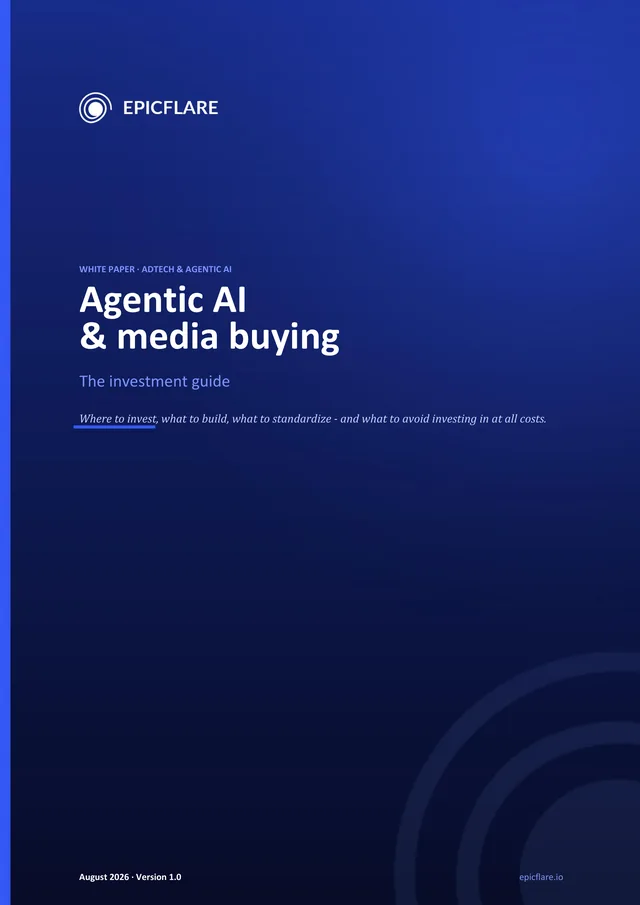
Go further
Agentic AI and media buying: An investment guide
A framework for assessing architecture, interoperability, operating costs and control when investing in AI for media buying.
PDF · 27 pages · Free · one short form unlocks every resource
Related reading
- Building an AI Workflow: Start Small, Evaluate, Expand
Scope an AI workflow around one operational task, define evaluation criteria and add complexity only when testing shows it is needed.
- AI for Ad Operations: From Request to Controlled Execution
Explore an AdOps workflow for deal requests, with explicit business rules, human approval and practical criteria for evaluating AI support.
- Bringing AdTech Expertise into AI Workflows
Turn platform knowledge, business rules and operational playbooks into AI workflow requirements, then test how reliably they are applied.