
Marketing Organization Shift: How AI Agents Could Change Marketing Roles
Generative AI is already used to produce ad assets and to support media planning and trading. Agentic systems, which can carry out multi-step tasks with limited supervision, are still far from mature. If they progress, they could change the roles of marketers and the structure of agencies and brand teams. This article looks at possible scenarios; none of them is inevitable.
By EpicflarePublished Updated 3 min read
A First Step: Integrate and Learn
Marketing teams can start with a mix of human-led workflows and AI assistance. Often this means generic agents embedded within major platforms (Google, Meta) or offered by specialized third-party tools, designed to handle specific tasks such as creative variant generation or media buying optimization.
The first step for marketers is to learn how to operate these systems well. An AI agent’s output depends on the instructions and context it receives. Vague inputs tend to produce generic results. Better results depend on:
- Structured instructions: Moving beyond single commands to instructions with context, constraints and specific goals.
- Data-rich inputs: Providing agents with accurate first-party data, brand guidelines and historical performance metrics to inform their decisions.
- Supervised execution: Treating AI as an extension of the marketer’s own expertise, which means reviewing, correcting and refining the agent’s output.
The “test and learn” method applies to the AI tools themselves, not only to campaigns.
A Possible Evolution: From Generic Tools to Custom Agents
As teams gain experience with generic agents, some will reach their limits. Developing custom AI agents tailored to specific business needs, complex ecosystems and specialized jobs may then become relevant. This can happen in two ways:
- Platform-led customization: Ad platforms may offer features to adapt their native agents to a brand’s own logic and processes.
- Bespoke agent development: Brands and agencies may build or integrate their own agents to handle specific workflows.
If these agents prove reliable, they may take over a growing number of tactical tasks.
This does not mean marketers can disengage. It calls for deeper expertise: marketing judgment combined with an understanding of how to design, test and refine AI systems.
A Changing Role: Managing AI Agents
Some operational tasks, such as trafficking, basic reporting, A/B test setup and initial media planning, may be partly handled by AI agents where testing shows they are reliable.
In that scenario, part of a marketing manager’s work shifts toward supervising AI agents. The responsibilities would include:
- Performance monitoring: Auditing each agent’s output against the KPIs used for the task.
- System architecture: Designing and orchestrating workflows where several specialist agents (e.g., a creative agent, an audience agent, a bidding agent) work together.
- Expertise injection: Acting as the human in the loop, providing the strategic insight, creative judgment and business context that the AI does not have on its own.
This calls for two kinds of expertise: knowledge of the marketing domain (creative, media, etc.) and the ability to operate AI systems.
What This Means for Team Structure
AI adoption can change how operational work is distributed, but the outcome depends on the tasks, tools and organization. Start by identifying repeatable activities and testing whether assistance improves quality or reduces workload.
Automation still requires development, integration, monitoring and human review. Its cost and value should be measured against the existing process.
Roles may evolve toward reviewing outputs, handling exceptions, maintaining business rules and improving workflows. Team structure should follow demonstrated needs and results, rather than an assumption that AI will replace particular roles or levels of seniority.
Go further
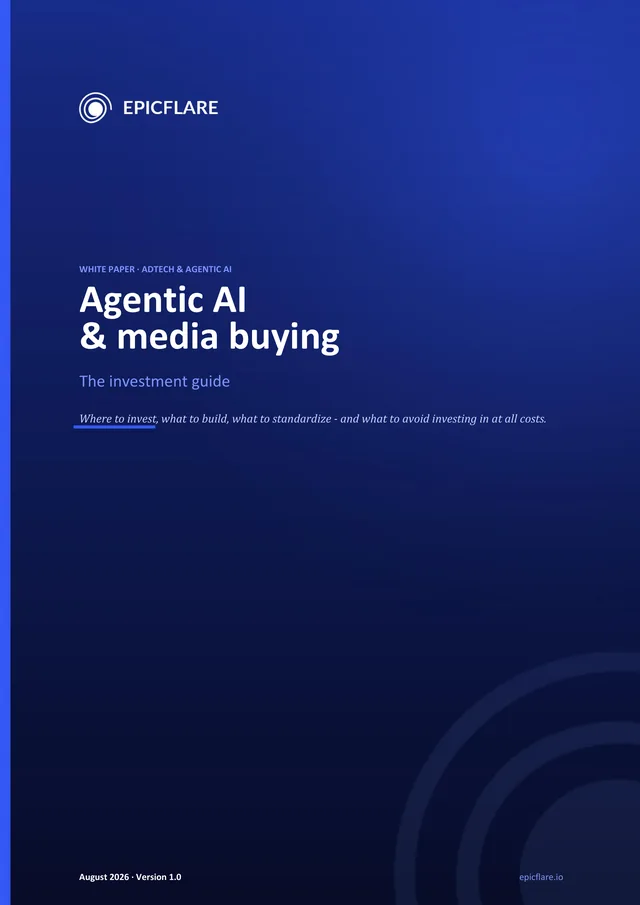
Agentic AI and media buying: An investment guide
A framework for assessing architecture, interoperability, operating costs and control when investing in AI for media buying.
PDF · 27 pages · Free · one short form unlocks every resource
Related reading
- AI for Ad Operations: From Request to Controlled Execution
Explore an AdOps workflow for deal requests, with explicit business rules, human approval and practical criteria for evaluating AI support.
- Bringing AdTech Expertise into AI Workflows
Turn platform knowledge, business rules and operational playbooks into AI workflow requirements, then test how reliably they are applied.
- AI Agents or Automated Workflows? Choosing the Right Approach
Compare AI agents and automated workflows through task requirements, control, evaluation and operating cost to choose a suitable starting point.
- Building an AI Workflow: Start Small, Evaluate, Expand
Scope an AI workflow around one operational task, define evaluation criteria and add complexity only when testing shows it is needed.